


Robotic Surgery
- Home
- Specialities
- Robotic Surgery
Overview
At Aykai hospital we are committed to deliver the highest standards of clinical excellence and that’s why we continuously invest in innovative technologies of the future to ensure our patients get the best care.
Aykai Institute of Robotic Surgery is one of the largest robotic surgical programmes in India, which combines the advancements of robotic systems and the experience of specialists to make patient recovery easier and faster.
Advantages of Robotic Surgeries over Conventional Surgeries:
- Minimally invasive
- Greater precision
- Reduced blood loss
- 3D surgery powered by Artificial Intelligence
- Faster recovery
- Short hospital stay
What is Robotic Surgery
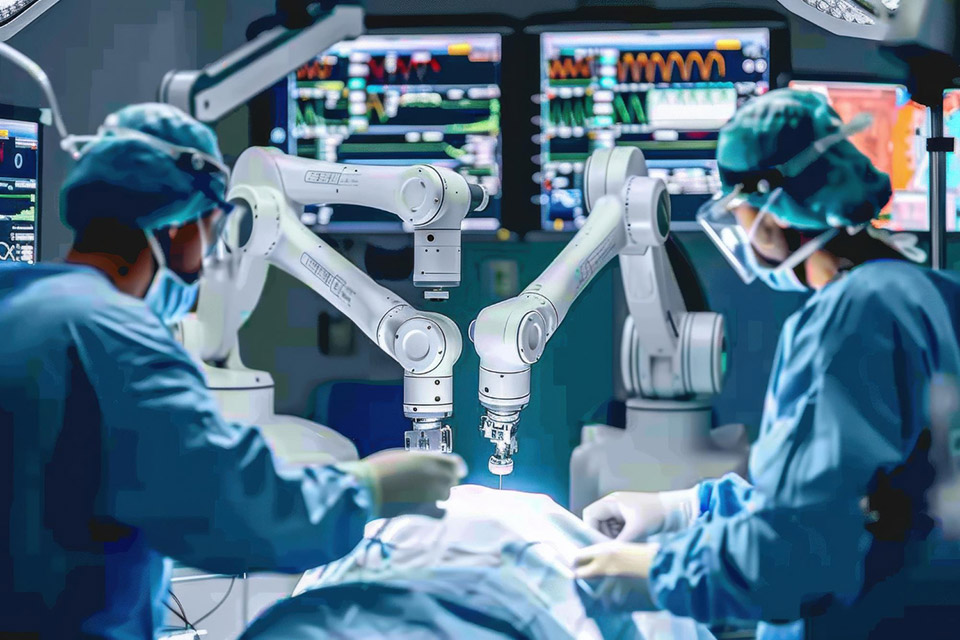
Robotic surgery is a type of minimally invasive surgery in which a surgeon uses a computerized robotic system to perform an operation through small incisions.
How it works
A robotic surgery system typically has three main parts:
- Surgeon’s console – where the surgeon sits and controls the instruments.
- Robotic arms – hold tiny surgical instruments and a camera.
- High-definition 3D camera – provides a magnified view of the surgical area.
Benefits
- Less blood loss
- Reduced pain after surgery
- Shorter hospital stays
- Faster recovery
- Greater precision in delicate procedures Conditions Treated
Technology
Powered by the CMR Versius® Robotic Surgical System, Aykai Hospital combines advanced robotic technology with the expertise of experienced robotic surgeons to deliver precise, minimally invasive treatment. The result is enhanced surgical accuracy, smaller incisions, faster recovery, and a better overall patient experience.
Doctor Information

Dr. Baldev Singh Aulakh
Chief urologist, Robotic & Transplant Surgeon
Dr. Amit Tuli
Urologist, Robotic & Transplant Surgeon
FAQs
1. What is robotic surgery?
Robotic surgery is a minimally invasive surgical technique in which the surgeon controls robotic instruments from a computerized console. The robot enhances the surgeon’s precision, flexibility, and control—it does not perform the surgery on its own.
2. Is the robot performing the surgery by itself?
No. Every movement is controlled by the surgeon in real time. The robotic system cannot make decisions or operate independently.
3. Is robotic surgery safe?
Yes. Robotic surgery is a well-established and safe surgical option when performed by trained and experienced surgeons. Like any surgery, it carries some risks, which your doctor will discuss with you.
4. What are the benefits of robotic surgery?
- Smaller incisions
- Less pain
- Minimal blood loss
- Lower risk of infection
- Shorter hospital stay
- Faster recovery
- Better cosmetic results
5. Which conditions can be treated with robotic surgery?
Robotic surgery is commonly used for:
- Prostate Cancer
- Kidney Cancer
- Bladder Cancer
- Adrenal Tumors
- Hernia
- Gallbladder Diseases
- Gynecological Conditions
- Selected colorectal and thoracic procedures
6. Am I a candidate for robotic surgery?
Not everyone is a suitable candidate. Your surgeon will evaluate your medical condition, overall health, and the type of procedure to determine if robotic surgery is the best option.
7. Will I have large scars?
No. Robotic surgery uses small keyhole incisions, which usually result in smaller scars and better cosmetic outcomes compared to open surgery.
8. How long does recovery take?
Recovery varies depending on the procedure, but many patients return to their normal daily activities sooner than after traditional open surgery.
9. Is robotic surgery more expensive?
The initial surgical cost may be higher than conventional surgery. However, shorter hospital stays, fewer complications, and quicker recovery can reduce overall treatment costs.
10. Does robotic surgery cure cancer better than traditional surgery?
The primary goal of robotic surgery is to achieve the same or better cancer control while improving surgical precision and reducing recovery time. Outcomes depend on the type and stage of cancer, as well as the surgeon’s expertise.
11. Is robotic surgery painful?
Most patients experience less postoperative pain than with open surgery because the incisions are much smaller.
12. How long will I stay in the hospital?
Many patients are discharged within 1–3 days, depending on the type of surgery and their recovery.
13. When can I return to work?
Many patients resume light work within 2–4 weeks, although this varies depending on the procedure and individual recovery.
14. Can elderly patients undergo robotic surgery?
Yes. Many older adults can safely undergo robotic surgery if they are medically fit. Your surgeon and anesthesiologist will assess your overall health before recommending surgery.
15. Why choose Aykai Hospital for robotic surgery?
At Aykai Hospital – Institute of Uro-Oncology & Robotic Cancer Surgery, patients receive advanced robotic surgical care from experienced specialists using modern minimally invasive techniques. The focus is on precise treatment, faster recovery, and personalized patient care.
Robotic surgical systems are used in various surgeries such as:
Robotic Urologic Cancer Surgery
Robotic surgeries have made the management of complex urological malignancies easier, safer and more desirable to both the surgeon and the patient. Commonly performed surgeries in this field include robotic surgery for prostate cancer(radical prostatectomy), complete or partial removal of kidney for kidney cancer(Radical or Partial Nephrectomy), urinary bladder cancer(Radical Cystectomy), lymph nodes removal for testicular and penile cancer.
Robotic URO Reconstructive Surgeries
Robotic technology has transformed the landscape of urologic reconstructive surgery. With enhanced visualization, tremor-free instrumentation, and precise articulation, surgeons can navigate complex anatomy with unparalleled accuracy — delivering superior outcomes with minimal patient morbidity. Commonly performed surgeries in this field include, Pyeloplasty, Ureteric re-implantation, Boari flap reconstruction etc.
Procedures:
- Pyeloplasty
- Ureteric Re-implantation
- Boari Flap Reconstruction
- Other Reconstructive Urologic Procedures
Robotic General Surgeries
Robotics, in general surgeries include Gallbladder stones, Hernia Surgery, Appendicitis, Fundoplication and other general surgeries can be robotically performed with ease.
Robotic Gastrointestinal Surgery
Robotic surgery is performed to treat many types of gastrointestinal cancer, such as oesophagal cancer, gastric cancer, rectal cancer, and hepatopancreatobiliary cancer.
Robotic Kidney Transplant
Robot-Assisted Kidney Transplant (RAKT) is a minimally invasive technique that uses robotic support to perform a kidney transplant. RAKT is performed under the supervision of transplant surgeons specialising in robotics and transplant surgeries.
Compared to conventional open kidney transplant surgery, a much smaller incision of about 7 cms is made in RAKT to place the donor kidney into the abdomen, stitch the blood vessels, and the ureter. Then, another four or five small incisions of size 0.5 to 1 cm approx. are used to insert the instruments into the abdomen.
Robotic Head and Neck Cancer Surgery
Trans-Oral Robotic Surgery (TORS) is the latest and emerging technology which offers several advantages over other available treatment options. It allows the surgeon to reach difficult to access areas in the throat or within the neck and remove the tumour through small robotic arms. These can be placed inside through the mouth or through very small or inapparent incisions over the neck. TORS provide a broader view, high-resolution, and magnified three-dimensional optics for determining the specific mucosal surfaces of the head and neck through an endoscope.
This technology can be used for selective cancers/tumours of the throat like tonsil, base of tongue, thyroid, parapharyngeal space and neck.
Robotic Joint Replacement Surgeries
Robotic joint replacement surgeries have shown remarkable results compared to traditional knee replacements. Over a period of time, robotic knee surgery has evolved as a powerful and satisfactory tool for doctors. Doctors use a robotic surgical arm to accomplish parts of the procedure, assisting in areas that require the steadiest hand and navigating small places. Using CT scans, the robotic arm can work from 3D images of the surgical area and perform a range of tasks, such as:
- Preparation of the bone.
- Introduction of the implant.
- Balance the implant.
- Check for the appropriate fit.
Robotics in Weight loss surgeries (Bariatric)
Robotic bariatric surgery is a novel approach that is useful for people who wish to have sustained weight loss. This procedure is safe and effective, and doctors can perform both gastric bypass, sleeve gastrectomy & other weight loss procedures.
Robotic Gynaecological Surgeries
Robotic gynae surgeries offer even better advantages, such as shorter hospitalization, less blood loss, faster recovery, better cosmesis and fewer to nil complications. In addition, robotic surgeries overcome the drawbacks of limited operative field visualization and the requirement for a skilled surgical assistant.
Some surgeries that are performed using robotic technology are:
Hysterectomy performed for different reasons, including:
- Uterine fibroids
- Uterine prolapse
- Endometriosis
- Abnormal vaginal bleeding
- Chronic pelvic pain
- Adenomyosis, or a thickening of the uterus
- Gynecologic oncology surgeries, often referred to as “Gynae Onco Surgeries,” are focused on the treatment of cancers in the female reproductive system, including ovarian, cervical, uterine, vaginal, and vulvar cancers. These surgeries encompass a range of techniques, such as radical hysterectomy, lymphadenectomy, oophorectomy, and tumour debulking.
Are you having health problems? Contact us today!
Call Us 24/7: 0161-525 25 25